In my recent post about unlearning fanfic-writing habits, I said that over-choreographing is the one I find most difficult to shake. Hopefully writing about over-choreographing will help me to do that.
What do I mean by choreography?
Choreography in books is not bad. In fact, it’s generally a good thing. This is where everything happens. Anything you describe to put a picture of the scene in your reader’s head is choreography: movements, actions, things going on in both the foreground and background of the scene. Teacups rattling in their saucers as a kaiju steps onto the street outside a cafe; two brothers playing football on the field while your main characters have a heart-to-heart conversation in the stands; wiping condensation from the surface of a cursed mirror, revealing someone else looking at you from the other side; dropping said mirror on the ground, shattering the reflection into tens of fragments of that horrifying, smiling face. This is all choreography, and it is good and necessary.
If anything, a lot of writers have a problem with under-choreographing their scenes. They suffer from ‘white room syndrome’, where a scene or entire book feels like it happens in a plain, lifeless void. They don’t mention the cafe doors clattering against the bell announcing customers coming in and out as their characters talk about the person they are both in love with. They don’t mention the cold spell, and how everyone’s wearing scarves, or cars passing on the street, their wheels making that very distinct grinding-splash sound car wheels make when rolling over wet tarmac. Their character doesn’t break up the phone-call dialogue to thank someone for holding the lift doors open as they struggle to hold their phone to their ear while carrying four boxes of limited edition dolls to their new flat. The author doesn’t tell us about the weird smell of the lift once they’re inside, or the way said character then chooses their words more carefully so as not to create a misunderstanding with the other person in the lift, who is clearly trying to act like they’re not listening in.
On the other hand, over-choreographing is when you go into a cinematic level of detail about what’s going on, often stating things your character would not be aware of to create a ‘picture’ in the reader’s mind in the same way a film or comic would. If you include too much choreography, it can get in the way of the story and become annoying to read.
When does a lot become too much?
This is a difficult question to answer, which is probably why I’ve found my problem of over-choreographing so difficult to shake. How much choreography is expected of you depends on the genre, your chosen style of writing and your target audience.
Some highly successful books are choreographed up to the ears, absolutely drowning in glances, sighs, smiles and blushes. The one that first comes to mind is Fifty Shades of Grey. I consider this a super over-choreographed book, and remember putting it down in the first five chapters specifically because I was annoyed by the way this “stoic” Mr Grey kept sighing over and over again, while continually being described as stoic and cool. You can’t say both of these things, I remember thinking, but it’s a hugely successful book. The threshold for acceptable choreography is very high in romance.
This book is also guilty of constantly mentioning things a character can’t be aware of, such as their own blushing. A particularly amazing example is this sentence: I inhale sharply, completely unaware that I’m chewing my bottom lip and my mouth pops open. (Excuse me as I throw my phone out the window in rage.) This is first person limited perspective!! You can’t just tell me as the reader that you’re doing a thing while admitting you’re unaware that you’re doing said thing, so couldn’t possibly be telling me about it!!! Augh!
And yet it works for the genre and audience. I say genre and audience here, because I don’t want to blanket-state that all romance authors/readers are going to be okay with this level of choreography. It worked for this story, maybe because the book already pushes readers to admit the things they guiltily wanted to read all along, and we do sometimes want to read books that feel like an over-the-top tv show you only watch when you’re sick in bed with the flu.
This isn’t the only time it’s ok to go ham on the choreography. It can be an effective style choice when used purposefully, and there are characters/povs that absolutely would be that aware of their own body to this extent, and who would describe actions and their surroundings with great detail. Noir in particular not only gets away with a lot, but rolls gleefully about in a lot and throws it at you and yells at you to enjoy it. For example, this bit in Savage Night by Jim Thompson:
    She turned her head sharply, her eyes blazing fire. But I was all wide-eyed and innocent.
    The fire died, and she smiled and squeezed my hand again.
    "It's sweet of you to say that, Carl, but I'm afraid... I get so damned burned up I- well, what's the use talking when I can't do anything?"
    I sighed and started to buy another drink.
It makes sense for a noir detective to be aware of- and play up- their own reactions, and to describe in detail what everyone else is doing, how they’re feeling, and the setting. This is all fodder for that bleak internal voice we love. This book is quite bare-bones in a lot of ways, the descriptions brief but vivid, and every piece of choreography is there because it serves a purpose. It can get away with a lot because it’s a little at the same time.
One of the issues I find with my own writing is over-describing the eye movements of my protagonist. She will glance here and look there, blink when she’s surprised and look at the floor when she’s feeling bad. Other characters will do it too. Everyone is always moving their eyes, and I am always describing it.
In Savage Night, these looks are also described quite often: He took his pipe out of his mouth, and looked into the bowl. He glanced up at me, and he chuckled. Unlike the usage in my own novels, this example works. It is placed purposefully just in that spot in the dialogue, to create a pause mirroring the thoughts of the described character. He’s a bit surprised by the statement our protagonist has just made, but can’t argue with it, and is deciding how to proceed with the conversation.
In contrast, I tend to use people glancing or looking at one another just to fill space because I don’t like how bare dialogue looks on the page:
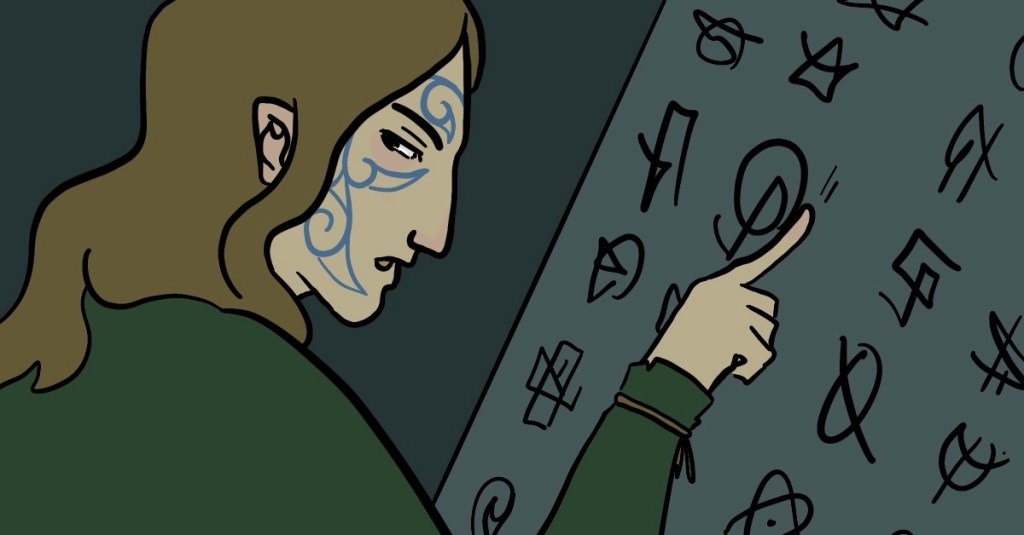
    The woman sighed, running a finger along the slate beside one of the patterns. “She eats bread.” She looked sideways at Eilaf, who was just realising that the woman was mad after all.
    “Who does?” she asked, against her better judgement. There was no one else in the room with them, and the only person they’d spoken about was Uweth, who was a man.
    Scren tapped the pattern. “That’s what it says here. She eats bread.”
The woman looking sideways at Eilaf here is fine. It’s fine, but it isn’t purposeful. When you take it alongside the other 300 times characters are specifically mentioned looking at things or one another, it becomes noise. It doesn’t say anything about either character, and it doesn’t add anything to the scene to have her look sideways here. I wrote it in simply because I felt like something should be there. This is also fine:
    The woman sighed, running a finger along the slate beside one of the patterns. “She eats bread.”
    “Who does?” Eilaf asked, against her better judgement. There was no one else in the room with them, and the only person they’d spoken about was Uweth, who was a man.
    Scren tapped the pattern. “That’s what it says here. She eats bread.”
I could take out even more, be a bit more specific in my description too, and lose nothing:
    The woman ran a finger along the slate beside a small, round pattern. “She eats bread.”
    “Who does?” Eilaf asked, against her better judgement. There was no one else in the room with them, and the only person they’d spoken about was Uweth, who was a man.
    “That’s what it says here. She eats bread.”
So I suppose you could say that over-choreographing is when you habitually add choreography that doesn’t add to atmosphere, plot or characterisation. Now that I think about it, that’s fairly obvious, but it’s difficult to notice yourself doing it.
I found it useful to write this post, and particularly to go through that little piece of dialogue. Editing out unnecessary choreography was a good exercise. I’d actually searched through the novel looking for examples where people looking at stuff was unnecessary, and every time I found an example I went “no but I need this because…” I reached the end of the doc with 0 examples, knowing I was wrong, and made myself go back through it more honestly.
Anyway that’s it for this week!


Leave a Reply