I thoroughly enjoyed poring through The Mabinogion in search of lovely sentences, so I’ve decided to do the same with a more recent favourite of mine: Rumer Godden’s 1939 novel, Black Narcissus.
Honestly, skimming through it now, I don’t know how one could choose just three sentences from this book. It’s artfully written. Every sentence is a sentence worth showing, although they’re so tightly woven together that it’s hard to take a sentence out on its own while maintaining everything that makes it beautiful.
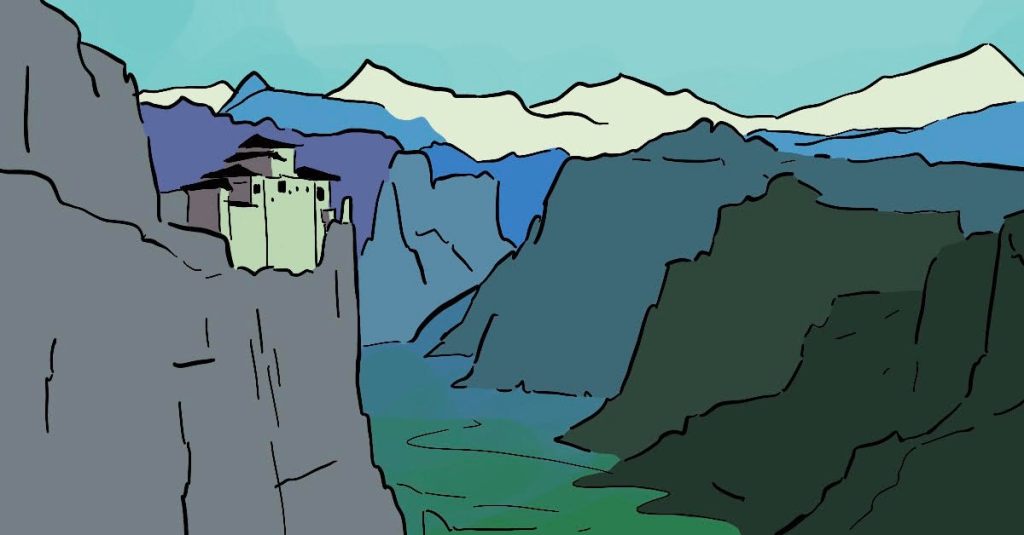
With so many sentences to choose from, I thought I’d focus on three sentences describing Mopu – the abandoned palace in the Himalayas where the book takes place. The descriptions of place in this book are awesome imo.
You noticed the gulf where the birds flew level with the lawn; across it was the forest rising to bare and bony ridges, and behind them and above them, the Himalayan snows where the ice wind blew.
Chapter 3: the view from Mopu.
This sentence comes from one of the opening descriptions of Mopu and its surroundings, and I think most readers would overlook it in favour of the many more beautiful descriptions, but this one really catches me: where the birds flew level with the lawn.
I grew up on a remote hillside in Wales, and now live high on the side of a valley, and there is something magical about looking out of the window and seeing birds fly past at eye-level: not garden birds picking seeds out of cages, but gulls and crows and herons soaring high over the trees, right beside you. The feeling that the ground isn’t there, that the valley and its river and its neat rows of red brick miners’ houses, their roofs a patchwork of shining slate, concrete and red bitumen, don’t exist. You look straight out and there’s just the hill on the other side, covered in trees, and above it the sky.
When I moved here, people asked why I chose this house, this valley. I told them it was because of hiraeth. A longing for home that had ached in my chest all my life, and that disappeared the moment a flock of swallows swept past the living room window. When I read that sentence in Black Narcissus, I felt a bit of hiraeth again. A bit of longing and grief.
If this little valley and its little hills and little trees can inspire such strong feelings of peace and solitude in me every morning as I sit next to the window with my coffee and morning pages, then I can’t imagine how much greater that feeling would be at Mopu.
There was no such thing as privacy at Mopu, every sound was carried through the house and the rooms were built of windows opening on the endless corridors where the servants and workmen came walking by; and yet sometimes there was that sense of emptiness that was almost frightening, as if the house had swallowed everyone; you could walk in it for minutes and meet nobody.
Chapter 7: the palace at Mopu.
It’s impossible to read this novel without relating everything to yourself, your history and thoughts. It’s such a personal book. It reaches right into the souls of the Sisters and brings out what they’ve hidden from themselves, and it reaches into the souls of its readers as well.
This passage in particular hit me with a strong sense of nostalgia for the house I grew up in. Just as Sister Clodagh found her mind always drifting back to her childhood in Ireland, mine went to Wales.
I’ve never read a better description of the feelings of liveliness and emptiness that co-exist in big, remote houses. The workers and the constant noise and movement, and then those moments where the silent universe has invaded the space, or perhaps that you are an invader on the silent universe, and you’re alone, surrounded by others who are also alone.
You’ve probably felt it yourself, maybe walking down a corridor after-hours at college, or through a shopping complex a few minutes after opening. The strange little fear that everyone’s gone, and then the relief that makes you feel silly, when you see someone else walking by, tapping away on their phone. It’s all normal again, all fine, but the moments of silence stay with you.
The light spread, there were long lines of cloud in the sky and presently above them the outline of the snow peaks appeared, cold and hard as if they were made of iron; they turned from black to grey, to white, while the hills were still in darkness.
Chapter 31: sunrise at Mopu.
I just love this. The way the sentence expands upwards and then falls down to the valley. The clouds, which we think of as the highest things, being dwarfed by the mountains looming over them. How the light hits the peaks first, bringing dawn to the mountaintops long before there’s even a grey semblance of light at their feet.
It feels almost holy, and you can understand why mountains have been thought of as gods in many cultures, with their heads bathed in light. Really beautiful.
This is fun. I’m not sure what book I’ll look at next, or if I’ll come back to Black Narcissus and choose three sentences about Ireland, or three sentences about the Sisters. Either way, it’s fun. Thanks for reading!
 Non Hughes
Leave a comment