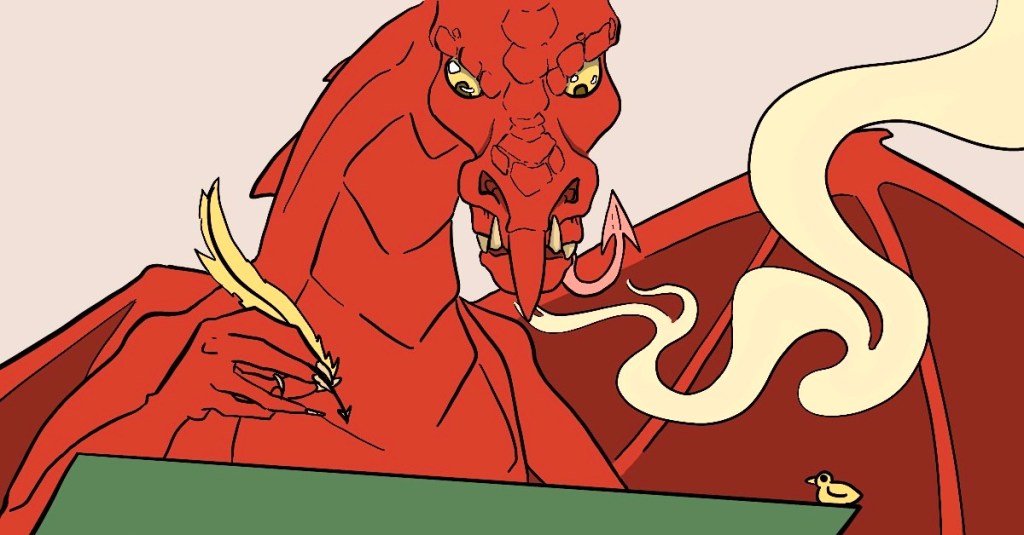
My first language is Welsh, and I don’t write in it.
Apart from a near-constant quest to write a decent englyn, I haven’t written a piece of fiction in my native language since secondary school. I’ve barely thought about it.
Why don’t I, though?
That’s the question mam asked me a few months ago, making faces over my nephews’ tiny collection of Welsh-language books. “It’s all rubbish,” she said, to which I became mightily offended because I grew up just fine with Sali Mali and Rala Rwdins, thank you. And that one with little yellow ducks hidden on every page… It’s an absolute classic, so much so that I cannot remember its name.
I waved her off. Why don’t I write in Welsh? Dunno. I just don’t. But then on the long, long drive home, I couldn’t get the idea out of my head. Why don’t I? Do I not love my language enough? Is this the language version of internalised homophobia?
(Unrelatedly, I made a vow of courage to keep writing this weekly newsletter until at least Christmas, so am willing to make a post out of any and all thoughts that come into my head, including this one.)
So here we go. Here are the reasons I don’t write in Welsh.
Vocabulary
I speak Welsh fluently… As in, I speak house-Welsh fluently, with a lot of English mixed in. In informal Welsh, you don’t need to worry about trivial things like sentence structure, spelling or pronouncing any of the letters whatsoever out loud. You can condense burdensome sentences like “Wyt ti wedi bod i mewn i’r dref eto?” (Have you been into town yet?) to “Ti di bo’r dre to?“, with an efficiency improvement of almost 60%. It’s also a readability deterioration of the same amount.
In the Welsh-English hybrid called Wenglish (or Cymsneg, in Welsh), which is used by most of the Welsh-speaking population, you don’t actually need to know that many Welsh words. I don’t know how to say ‘headphones’, for instance, or ‘nostalgia’ or ‘sun cream’, as I’d usually say the English word in an otherwise Welsh sentence and go about my day.
I felt this very keenly in secondary school, as a straight-A student who struggled to scrape a B in Welsh language exams. I even hid a vocabulary of adjectives inside my copy of Dros Bont Brooklyn (A View From the Bridge) and snuck it into a GCSE drama exam. Didn’t do much good though, as I couldn’t remember what half of them meant.
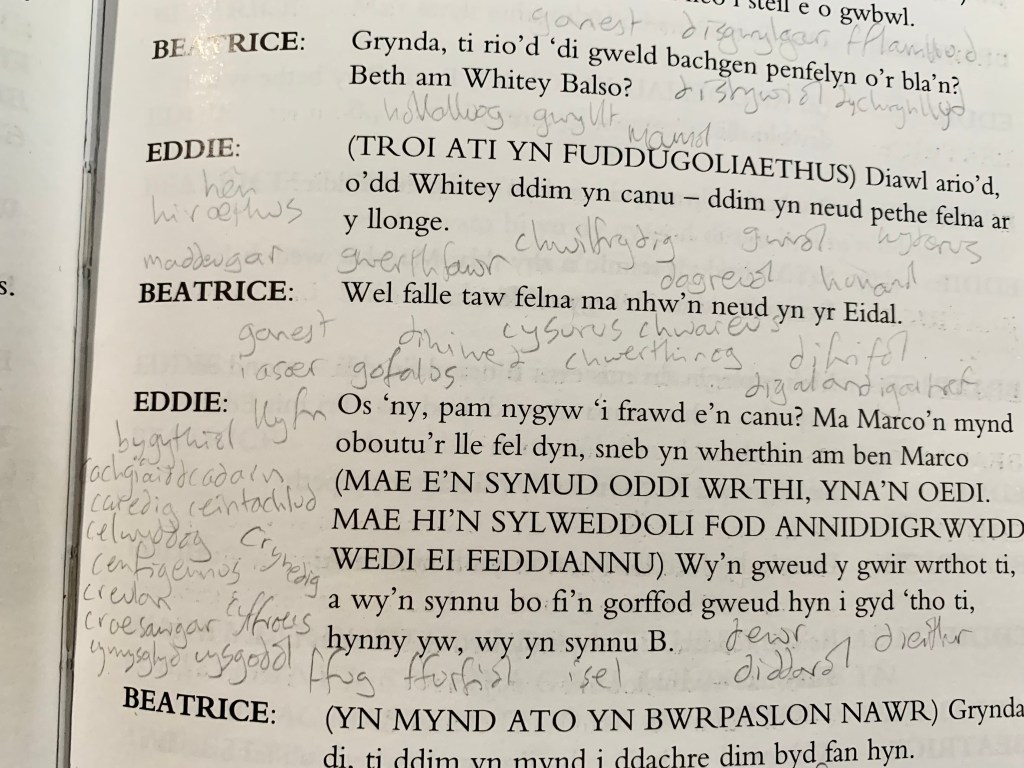
They’re grouped by letter of the alphabet because I copied them over from a Welsh dictionary. I have no idea what ‘croesawgar‘ means (second from bottom left), but it sounds awesome.
Speaking of dictionaries, you might be wondering why I don’t just use Google Translate or similar to find the words I don’t know by heart?
Dialect
Automatic translation services, in my experience, tend to suggest North Wales variants for words and sentences. People from North Wales will probably tell you the opposite. The truth might be that Google Translate is simply not aware of dialects, or that people might want to stick to their own. As a proud Southerner however, I couldn’t possibly use words like ‘nacw’ or ‘amdani’, and I’d be terribly embarrassed to mix dialects within a text simply because I don’t know which words are from where…
To complicate matters, I recently learnt that I speak an even smaller distinct dialect from North Pembrokeshire. I was always aware that this dialect existed, but assumed I spoke the ‘normal’ South Wales tongue (aka Cardiff Welsh) until I joined a discord of Welsh speakers and found they’d never heard many of the words I was using before. For me, ‘so fe‘ is the correct way to say ‘it is not’ and ‘we ti’ is the correct way ti say ‘were you’, but these are unfamiliar terms to most Welsh speakers. I talk and write like a 90-year-old farmer, basically. Or, as someone put it recently, a hambon (farmer-chav).
I’m proud to speak the dialect, and to do my part in keeping the language alive in general, but I feel self conscious of my dialect, and of the quality of my written Welsh in general.
It’d be really awful if I sent off a manuscript to a publisher and they wanted to edit it into ‘standard’ Welsh. Or worse, if it got rejected because my farmer Welsh isn’t, by nature, high enough a standard of writing to be considered in the first place. There are bigger problems to worry about when it comes to publishing in the Welsh language, though.
Publishing
As a writer with the end goal of being traditionally published, Welsh does not appear to be a smart choice. There are no literary agencies I’m aware of that take submissions in Welsh, and few publishers. Lists of Welsh publishers online go to broken urls of businesses from the 90s, or to book printing companies supporting authors to self publish. Even Y Lolfa, the biggest and most highly regarded Welsh-language publisher in the country, whose logo adorns the spine of almost every book I read growing up, has a note on their submissions page stating that they may ask for an “author contribution to the production costs”, and/or use grants from the Book Council of Wales in order to get the book made. In the English-language publishing world, a publisher asking you to put in money is a huge red flag, but it’s the only way Welsh services survive.
The ecosystem of agents, publishers and presses we take for granted (and complain about a lot) in English just isn’t there for Welsh writers, despite the best efforts of the publishers that do exist, along with authors, charities and the Book Council.
You really have to be the most passionate and patriotic person on the planet to go through the huge effort of writing and editing a novel in Welsh, knowing the state of publishing you’ll be met with at the end of the last page. (Unless self-publishing is already a thing you want to do, in which case thumbs up.)
So what?
I don’t know. I consider myself passionate and patriotic. I love Welsh. I love being Welsh. I even train my dogs in Welsh.
I just don’t know if I have it in me to sit down and spend hundreds of hours writing and editing a novel that in the very best case has only 1 decent publishing option, who I would need to pay for the privilege. It doesn’t seem like a smart use of my time or passion.
On the other hand, I might be totally overthinking how difficult it will be. Perhaps I’ll enjoy it and really love the process. I think I’ll try writing a single chapter in Welsh, and see how long it takes. If it’s not too bad, maybe it can be my side/relief project for when I’m feeling overwhelmed by my other novels.
Thanks for reading! Catch you next week, lovelies!
 Non Hughes
Leave a comment