Before I get into this post about bad habits I’ve been unlearning from my fanfic-writing days, a note to say: I love fanfiction. Totting up the ones with the biggest word-counts that I remember off the top of my head, I’ve written over a million words of fanfic, and read over fifteen million. This is not in any way a fanfic-bashing post.
Having said that, it happens to be that some of the common habits that make fanfic writing (and reading) so enjoyable are undesirable when writing for traditional publishing. I’ve made a focused effort this year to unlearn four of these habits, so let me tell you about them, in order from most to least successful…
Not telling the reader about my world
Okay, in my opinion this is the single largest skill I was missing when moving from fanfiction to original fiction: knowing when and how to tell your readers the world-building stuff. Not the world-building itself, I really enjoy that and can quickly spin up any type of society or environment I like. It’s just… telling people about it is hard.
When you write fanfiction, you don’t need to tell your readers about the world unless you’ve made changes to canon. You don’t need to put in explanations or info-dumps about how trainee ninjas progress if you’re writing Naruto fanfiction, because your readers have already read the manga. You don’t need to tell readers of your Harry Potter fanfiction that it’s set in a boarding school, or that it’s the norm for most students to go home over the Christmas holidays, or what Butterbeer tastes like. They fill the details in themselves. You don’t need to explain the backstories or personality traits of your characters when writing Star Trek fanfiction, because your readers have watched the show: they know that Data is an android capable of taking over the ship whenever he likes, and they know the depth and limitations of his emotions, and that he likes to paint in his spare time. You don’t need to tell your reader anything – not the layout of a building or the way the magic system works, or the attitudes or beliefs of the society your characters live in.
When you’re writing original fiction on the other hand, you have to show or tell them everything (-that’s relevant to your plot).
My books are set in a richly fleshed-out world. The magic system has rules, and the various social groups each have their own beliefs and values, along with opinions and misinformation about those of the other groups. The country has four hundred years of history, fragments of which exist in folklore and songs passed through the centuries, some of it true and some of it propaganda or exaggerations. There are races that have gone extinct or been displaced from their homelands, and those whose core beliefs used to be drastically different from the ones they now follow. It is a world bursting with lore… in my head.
On paper? Not so much. This is something I continue to work on, but the phases of learning have so far gone like this:
Phase 1: nothing is explained, and I don’t notice the missing information because it exists in my head as I’m reading back over my work.
Phase 2: each chapter contains at least one huge info-dump paragraph about things I think the reader needs to know to understand what’s going on.
Phase 3: info-dumps have been spread out into little pieces integrated into the chapter, with a more sensible balance of show vs tell, but I am still explaining things way too deeply.
Phase 4: the future, hopefully, when I have obtained the secret recipe to just enough information given in just the right way.
I really love beta readers for checking this stuff because they don’t have the information in their heads, and can easily inform you of confusing moments or missing knowledge. They’ve also been great for letting me know what real-world vocabulary I use without realising they’re not commonly understood, e.g. coracles (single person boats made of willow and leather), torqs (necklaces of twisted gold wires, worn by chieftains) and quern stones (for grinding flour).
On the other hand, knowing when to lean into your readers’ knowledge can be a strength. You don’t have to create and explain every single thing from scratch. For example, I created a group of druid-like people for my Iron Age books, who were called drai (singular) or draedi (plural). I had to explain a lot more about this group’s role in the world to make readers understand that they’re basically druids, than if they were simply called ‘the druids’ to start with. After changing just this one name, the feedback of confusion I was getting around the magic/divinity system disappeared.
Over-use of verb descriptors
Can’t escape this. There are plenty of fanfic writers out there who don’t go for overly flowery language, so it might be unfair to make this generalisation, but I’ll say it anyway. There is too darn much whispered quietly going on out there. Too much smirked smugly, and certainly too much bellowed angrily. Too much verbing adverbly in general, and even the verbing un-adverbly can be unnecessary – she growled.
I put this down to the fact that the fanfic boom started with older millennials, and we were taught in school to avoid ‘said’, ‘moved’ or ‘walked’ at all costs.
As an example of these teachings, I found the following papers in my Writing References folder (a bulging lever arch file containing every piece of advice, story idea or webcomic I have received, written or drawn since 2002).
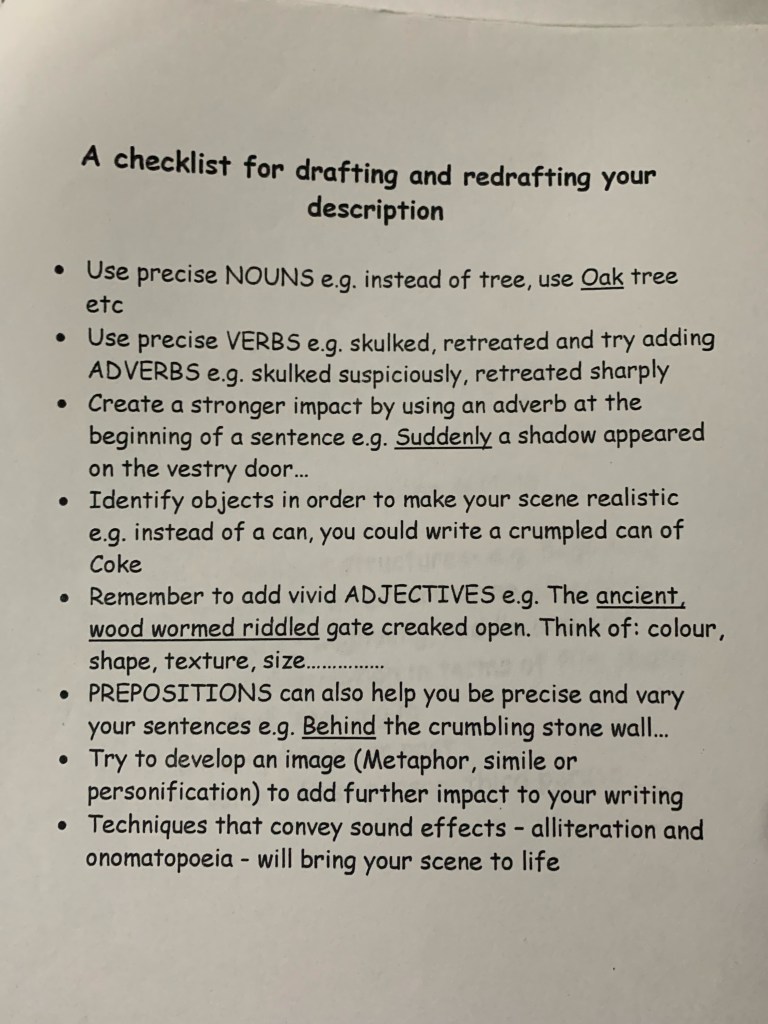
I got this print-out in school when I was 13 or 14 years old, and it gives awful advice!! What kind of skulking is not suspicious, huh? And don’t get me started on ‘suddenly’, or ‘the ancient wood wormed riddled gate creaked open’.
(Although they get points for using Comic Sans.)
This resource prompted me to create pages upon pages listing words I could use instead of say, look, move, walk, think…
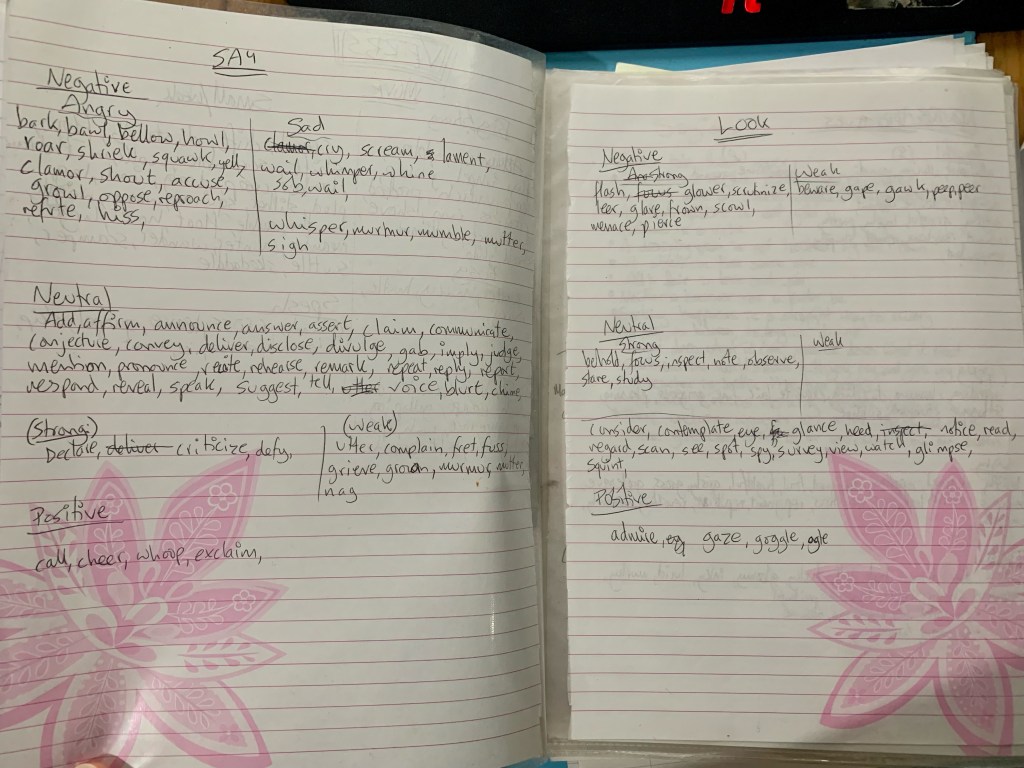
“Wow I can’t wait to prove my writing skills by using she asserted and he judged instead of boring old said!” – me, 2007.
Is it any wonder I ended up writing cringe-worthy paragraphs like this?
She squinted up at him. “I don’t want to go back,” she croaked. Her voice was desperate, her forest eyes wide as they looked deep into him.
Or like this?
    "Me?" Lestrade blurts incredulously. "You think I'm the one acting weird?"
    "First you were cold. Then you were welcoming. Next you were annoyed, then pleasant, and then cold once more," the man lists.
    Lestrade huffs. "Yeah well, what about you?" he grumbles, annoyed. "You come in here for no reason, tell me it's a social visit and then proceed to not converse because I couldn't possibly have anything to say that you don't, in your great and vast intelligence, already know."
I do actually like the dialogue, but oh my days… Blurting incredulously… and thank goodness I wrote that it was annoyed grumbling as opposed to, I dunno, euphoric grumbling as a reader would no-doubt have otherwise assumed.
Along the same vein, fanfiction authors have a higher tendency than most to use descriptions to differentiate characters, eg the blue-eyed man did this, the taller woman did that… even when they are known, named characters. It was only this year that I found out you’re not really supposed to do it. For example, see this terrible sentence I once wrote:
Efan got another quick greeting and a nod, but then Gareth began picking food onto his plate and seemed to have no more patience for the younger man.
The ‘younger man’ in that sentence is Efan, the subject of the sentence. There is absolutely no reason to point our their age difference. It is irrelevant, and confuses the reader instead of clarifying things for them, as they have to stop and remember which character is younger.
Sighing, crying and blushing
Emma Thompson said in her ‘Movies That Made Me‘ interview that sighing and crying are two emotive actions that shouldn’t be overused. She was talking about acting, I know, but I remember watching the video a few years ago and instantly noticing how often my characters do both. Crying happens at least once per story, and sighing three or four times per scene. I started swapping these out for huffs, exhalations and breaths, before accepting that the writing is made stronger by removing 95% of them altogether.
I just did a quick search through some of the older docs on my drive, and they contain 5-10 sighs per 10,000 words. That’s up to 90 sighs per book!
Crying is more subjective. It depends on the story and your character, but emotions are usually elevated in fanfiction so your characters are more likely to cry multiple times in the same manuscript. I would use it as an easy way to show my character’s feelings, and hence make readers empathise with them, but crying too much weakens its impact. There are more meaningful and personal ways for characters to show (or hide) that they’re upset.
Moving on to blushing… This one’s a fanfic favourite. The main issue is that characters in fanfic are aware of their own blushing. They feel themselves blush, but we don’t in real life. We might feel a strong sense of embarrassment or attraction or whatever, but we don’t physically feel our own blushing. We can guess it’s happening, but we can’t feel the extent or intensity of it.
Worse is when the character tries to fight off this feeling, as occurs in this sentence I wrote five years ago: Calan snatched the peg and tucked it quickly into his pouch, fighting down a blush.
He doesn’t know that he’s blushing, and he wouldn’t be able to fight it if he did. What I wanted to say was that he’s fighting his feeling of embarrassment and trying to regain control, but I relied on this crutch to help me say it. The sentence is better off without the addition of the blush: Calan snatched the peg and tucked it quickly into his pouch. With the context of the scene and the dialogue around it, that action is enough to tell readers how he feels.
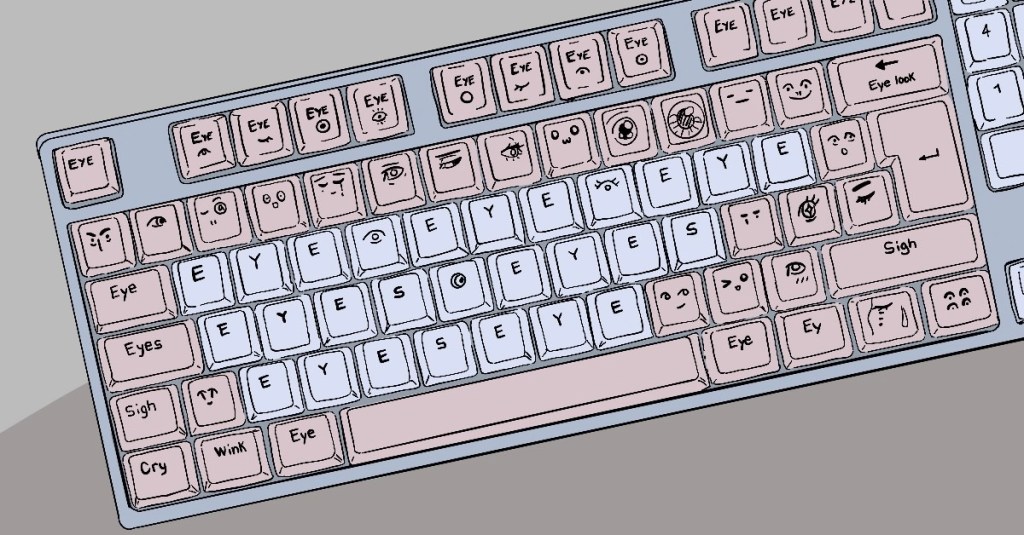
Eyes, eyes, eyes, eyes, eyes
Continuing the trend of overusing things… eyes. We fanfic writers love eyes. We love to describe them in detail, to mention them casually, to move them and widen them and make contact with them and open and close them, and generally mention their existence as often as possible, or else let the reader know where they are looking. If it’s not the eyes, it’s the eyebrows.
I’m reluctant to add it to the list, because I’m still a huge over-mentioner of eyes. In the 91,000 word novel I queried literary agents with this year, the word ‘eye’ is mentioned 228 times. That’s an eye every 400 words, through the entire novel. An eye on practically every page!
Try as I might, I can’t seem to escape this habit.
It can also be a symptom of a wider problem in the writing, which is the need to over-choreograph. Writers who mention eyes a lot (like meeeee) also tend to write in every little eye movement. Characters will look at a person, then at an object, or stare off into the distance. They will glance up at the ceiling, or down at the floor. They will look sideways at one another and furrow their brows at every opportunity, and probably bite their lips or their cheeks as well.
In the same book as the over-mentioning of ‘eye’, characters ‘look’ at things 301 times (once every 300 words) – and that’s not even counting all the glancing, peering, glowering and staring.
I think that what I’m supposed to be doing is just… describing stuff. Instead of saying ‘Gelert looked at the saddle, and saw that it had been magnificent once, but its finery was now scratched and scuffed away’, I could dive right into the description: ‘The saddle had been magnificent once, but the fine carvings in the leather were half scratched away, and the pommel was scuffed and worn, showing the copper underneath‘. I don’t need to tell readers that Gelert is looking at the saddle (in first person or third person limited) because we wouldn’t be learning about the saddle otherwise.
I’ve also retained the habit of mentioning gestures a lot. People wave their hands, tighten their fingers around sword hilts, rub the backs of their necks or tap their feet. The worst one is when they turn and twirl to face different directions. Sometimes I mention a character turning to face a new direction four or five times in a scene.
This is all part of the same habit of over-choreographing. While it’s not bad to mention these things every now and then, if they happen more than once or twice each in a book, there’s probably a problem.
Anyway, I’m working on it. The first step to solving a problem is admitting that you have a problem, and I admit it: I am an over-choreographer. I will try to get better.
Hope you enjoyed this self-bashing post! It was quite nice to look back at all the ways I’ve improved as a writer in the last few years, as well as the ways I can improve further. Growth mindset and all that. As pants as it is that I need to improve, I can’t think of anything more pants than feeling stuck. At least I know what to work on, and how I can keep getting better and better!
 Non Hughes
Leave a comment