The Mabinogion hold a very dear place in my heart, and have for most of my life, but I’ll be the first to say they’re not the world’s most accessible tales.
I’d loved the stories and characters for over a decade before I actually read a classical version from start to end. There are some stories I still haven’t read properly. They’re clunky, and the language is old-fashioned, and an entire scene with dialogue between three characters can go on in a single 3-page wall-of-text paragraph. I still love them though, and think they’re worth the trouble of slogging through for the chance of finding beautiful little diamonds.
I’d like to share with you three of my favourite sentences.
These are from Lady Charlotte Guest’s translation, as this is the most well-known and thus most widely available (to you, if you feel inspired to go and give them a shot yourself).
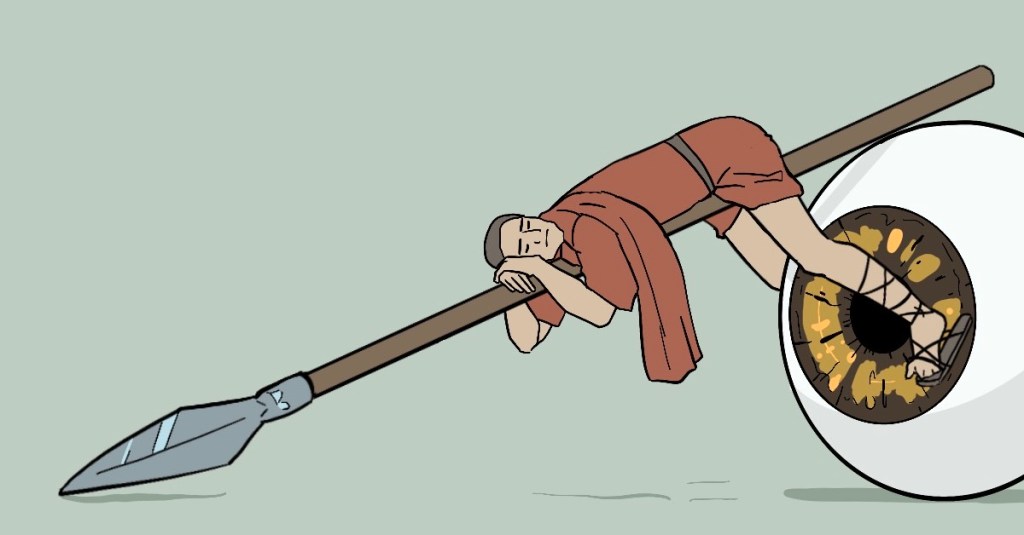
And in the youth’s hand were two spears of silver, sharp, well-tempered, headed with steel, three ells in length, of an edge to wound the wind, and cause blood to flow, and swifter than the fall of the dewdrop from the blade of reed-grass upon the earth when the dew of June is at the heaviest.
Describing Prince Culhwch’s spears in the story titled Kilhwch and Olwen, or the Twrch Trwyth.
I don’t think short sentences had been invented yet in the mid-nineteenth century, and clearly I was born in the wrong age, and should rather have been born in that time of disease, and industry, and excess commas, and of joining statements which would not belong in a single sentence together in this modern world of quick, accessible media and prose. Sorry, couldn’t resist.
There can be no greater description of a blade than “of an edge to wound the wind”. The alliteration is nice, and so is the flow when you speak it aloud. In fact that entire sentence speaks very well, with a gorgeous lilt.
And there’s no way you could get away with “swifter than the fall of the dewdrop from the blade of reed-grass upon the earth when the dew of June is at the heaviest” these days, but it’s wonderfully evocative. I can almost see that weighty drop dangling from the seed-head of a meadow grass on an early summer morning. So good. Love it.
If you’re wondering how long an ‘ell’ is, then you can probably keep on wondering to be honest. The English ‘standard’ was the length of the arm from shoulder to wrist, supposedly 45 inches, which is ludicrous because my arm including the hand is not even 30. Possibly the ell was originally half that, and the double-ell became the new ell over time, doubling the length of the original ell. Other countries in Europe standardised the ell at between 24 and 54 inches, so it varies a lot. It’s likely that the story uses the English standard, and thus the spear was 135 inches long, or 11 feet and a bit. So, as tall as two not particularly short people…
I have seen a dream. And in the dream I beheld a maiden, and because of the maiden is there neither life, nor spirit, nor existence within me.
Macsen Wledig (Magnus Maximus), Emperor of Rome, telling his counsel why he’d rather be sleeping right now than ruling his country in the story titled The Dream of Maxen Wledig.
Absolute mood. I too would rather be sleeping than facing my real-world responsibilities. Power to you, Macsen.
For those who don’t know, Macsen Wledig was the Roman emperor who apparently brought an end to the Roman presence in Britain, handing power back to local rulers and founding what later became the Welsh medieval kingdoms. According to this story in The Mabinogion, he does so because he falls in love with the literal woman of his dreams, who turns out to be Welsh. Obviously.
This sentence is all about the drama.
He’s in love with a woman he can’t meet in real life, and because of that he’s a husk of a man. He has neither life, nor spirit, nor existence within him – and this is him saying so, not the narrator. He’s basically showed up to a board meeting as the CEO and said those words to his stakeholders and direct reports. What a guy. Modern equivalent: a powerpoint presentation about this girl he met online called Elen, which could definitely be an email, and should probably be a text message to his therapist. 10/10.
And she seized a billet of wood and struck the blind Morda on the head until one of his eyes fell out upon his cheek.
Ceridwen, after finding out that her potion got ruined in the story titled Taliesin.
Sometimes you get thrown a sentence in a story that makes you go “um, sorry, you wot mate?” This is that sentence for me. I laugh every time I read it, because if you wrote something like that today you’d probably get a note from your editor reminding you that it’s not actually a thing. Like, people’s eyes don’t just pop out and dangle onto their cheek if you hit them on the head.
I love the contrast between the writing style and the action described in the sentence. When we say ‘X fell upon Y’, it’s usually something dainty and elegant, or at least intelligent. We fall upon clues and crowns fall upon heads. And here, an eyeball has fallen upon a cheek.
It reminds me of another sentence I love, from Roald Dahl’s poem Cinderella: “Her head went crashing to the ground, it bounced a bit and rolled around”.
It’s deliciously unexpected and graphic. Not something I’d write myself, but I love finding little gruesome treasures in older pieces of work.
Anyway, that’s three of my favourite sentences from The Mabinogion. I really enjoyed writing this, so I hope that you enjoyed reading it.
 Non Hughes
Leave a comment